


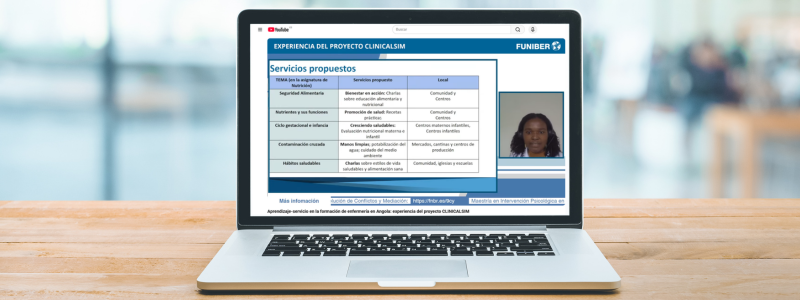
A recent webinar hosted under the ClinicalSIM project highlighted how service-learning is being used to strengthen nursing education and improve community health outcomes in Angola. The one-hour session brought together project leaders and educators to present a model that combines simulation-based training with real-world community engagement. The initiative, funded by the European Union and running from 2023 to October 2026, focuses on building capacity in health science faculties, particularly in nursing.
Opening the webinar, Thomas Prola explained the purpose of the session: “The idea behind this short hour is to introduce the audience to what we are developing in this project, in this case service learning as a methodology to improve training in health science faculties, specifically in nursing.”
He described ClinicalSIM as “a 36-month capacity-building project in Angola in health sciences colleges, specifically in nursing,” emphasizing its dual focus on technical and soft skills. According to Prola, the project integrates simulation training with community-based service: “Practical skills are developed through simulation and soft skills through a series of activities within the framework of the project.”
A key component of the initiative is its expected social impact. “We are aiming to reach at least 1000 people from the community.” Prola said, noting that these individuals will benefit from services aimed at improving nutrition, health awareness, and disease prevention.
Providing on-the-ground insight, Virginia Sumbo, professor at the Universidade Internacional do Cuanza (UNIC), outlined the urgent nutritional challenges facing Angola. “The nutritional situation in Angola is considered serious,” she stated, adding that “malnutrition claims the lives of Angolan children every day.”
She explained that the shortage of nutritionists makes it essential to train nursing students in basic nutrition services: “It is easier to find a nurse in a health unit in Angola than to find a nutritionist.”
Through the service-learning model, students first explore community needs. “We went to the communities to identify the main needs that the community has,” Sumbo said. These included “poor basic sanitation, low nutritional support and counseling, and the lack of nutrition services.”
Based on these findings, students design and implement targeted interventions. One of the most impactful approaches involves practical food education. “The population has the food… but they don’t consume it because they don’t know its nutritional value,” she explained.
This gap in nutritional education became a key turning point in the project, ultimately leading to the development of a project called MAHINE. Introduced during the webinar as a continuation of ClinicalSIM, MAHINE builds on these insights by focusing specifically on experiential nutrition education. While ClinicalSIM establishes the service-learning framework, MAHINE expands it, equipping students and communities with the tools to better understand and apply nutritional knowledge using locally available resources.
The initiative emphasizes hands-on learning. “We didn’t want to just stay in words, but in action,” Sumbo said, describing workshops where students demonstrate how to prepare nutritious meals using local ingredients.
Early results suggest a shift in community perceptions. “We’re receiving positive feedback, with people saying things like, ‘I didn’t know I could eat well with what I have’… ‘I thought eating well meant eating expensively’,” she shared.
The webinar also introduced a digital platform designed to support the organization and evaluation of these services. Kilian Tutusaus, Director of Educational Technologies at the Universidad Europea del Atlántico, explained that the tool helps structure the entire process.
“The functionalities can be summarized as being able to create and book services for the community,” he said, adding that it also allows users to “monitor the achievement of objectives.”
He clarified that the platform is not intended for constant daily use, but rather as a support system: “It’s not a tool to be connected all the time… it’s a tool to keep a record of everything that’s being done.”
The system also ensures accountability and tracking. “We can measure students who have not participated or actions that have been completed,” Tutusaus noted, emphasizing its role in evaluating outcomes and maintaining organization.
As the project progresses, organizers aim to expand its long-term impact by integrating service-learning into formal curricula. Prola highlighted this broader vision: “At the end of this project we have a prototype… that will allow us to give it many more years.
With implementation already underway and early feedback proving promising, the ClinicalSIM project demonstrates how combining education, community engagement, and digital tools can address critical healthcare gaps while preparing future professionals for real-world challenges. The webinar also highlighted how this work is extending beyond the initial project through MAHINE, a complementary initiative that builds on ClinicalSIM’s service-learning model to further develop experiential nutrition education. By translating the project’s findings into a broader, scalable framework, MAHINE reflects the long-term vision behind ClinicalSIM: creating sustainable systems that continue improving health outcomes and professional training well beyond the project’s official timeline.
