


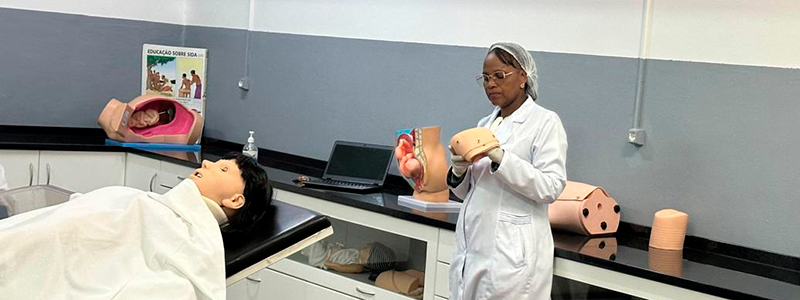
On May 13, the Polytechnic Institute of José Eduardo dos Santos University (IP-UJES) held Clinical Simulation classes at the Obstetric and Neonatal Nursing Teaching Laboratory on the topics: Prenatal Care and Clinical Stages of Labor, as part of our project, under the guidance of Professor Marlene Amorim.
The participants in the activity previously used the CLINICALSIM digital laboratory, which contains different simulation cases.
The objectives were to develop practical and technical-scientific skills and competencies among third-year students and to refine skills related to prenatal care, labor assistance, and management of the different stages of childbirth (dilatation, expulsion, placental delivery, and the Greenberg period).
During the class, led by Professor Marlene Amorim, students participated in simulated obstetric scenarios that replicated situations involving care for pregnant women during prenatal care and childbirth. The activities, conducted using equipment provided by the CLINICALSIM project, enabled training in technical skills, therapeutic communication, teamwork, and decision-making based on scientific evidence.
1. Prenatal Care
Prenatal care refers to the comprehensive care provided to women during pregnancy, with the aim of promoting maternal and fetal health, preventing complications, and identifying risk factors early on.
During the simulation, the main aspects of prenatal care were addressed, including the collection of the obstetric history and the performance of Leopold’s maneuvers:
- Calculation of gestational age;
- Assessment of vital signs;
- Measurement of uterine height;
- Auscultation of fetal heart rate;
- Ordering and interpreting laboratory tests;
- Guidance on nutrition, hygiene, vaccination, and physical activity;
- Identification of signs of pregnancy complications;
- Health education for the pregnant woman and her family.
The issue of providing a humane reception for pregnant women was also addressed, emphasizing active listening, respect, and professional ethics.
2. Stages of Labor
Childbirth is a physiological process divided into different stages that require continuous monitoring by the healthcare team to identify and prevent potential complications during labor and delivery.
Dilatation Stage
In this phase, the students practiced recognizing cervical dilation by monitoring uterine contractions:
- Assess cervical dilation;
- Observe signs of fetal distress;
- Learn how to measure cervical dilation using the simulators available in the ClinicalSim lab;
- Understand cervical changes from the onset of dilation to completion (10 cm);
- Provide emotional support to the laboring woman and her family;
- Encourage non-pharmacological methods for pain relief.
Expulsion Stage
This stage begins after complete dilation of the cervix and ends with the birth of the baby. In the simulation, students performed the following:
- Assisting the laboring woman during pushing;
- Proper positioning of the woman in labor;
- Perineal protection;
- Fetal monitoring;
- Delivering the newborn;
- Immediate care for the newborn.
Also at this stage, we emphasize the need for speed, organization, and efficient communication among the multidisciplinary team.
Discharge Phase
Delivery refers to the expulsion of the placenta and fetal membranes after the baby is born. During the clinical simulation, the following topics were covered:
- Identification of signs of placental abruption;
- Control of bleeding;
- Administration of uterotonic agents;
- Assessment of placental integrity, taking into account its constituent structures;
- Assessment of tears sustained during the expulsion stage, to perform perineal repair, cervical repair, and episiotomy repair, if necessary;
- Monitoring of the mother’s condition.
The students understood the importance of this phase in preventing postpartum hemorrhage, considered one of the leading causes of maternal mortality.
Greenberg Period
The Greenberg period corresponds to the first hour after delivery and is a critical time for monitoring the postpartum woman due to the increased risk of hemorrhagic complications. During the simulation sessions, the following were performed:
- Monitoring of vital signs;
- Assessment of uterine contractions;
- Check for vaginal bleeding;
- Monitoring of the postpartum woman’s general condition;
- Promotion of skin-to-skin contact between mother and newborn;
- Encouraging early breastfeeding;
- Checking the Pinard safety globe.
Conclusion
We can conclude that the clinical simulation classes conducted as part of the CLINICALSIM project, under the guidance of Professor Marlene Amorim, provide an essential experience for developing students’ skills and competencies in their professional practice.
