


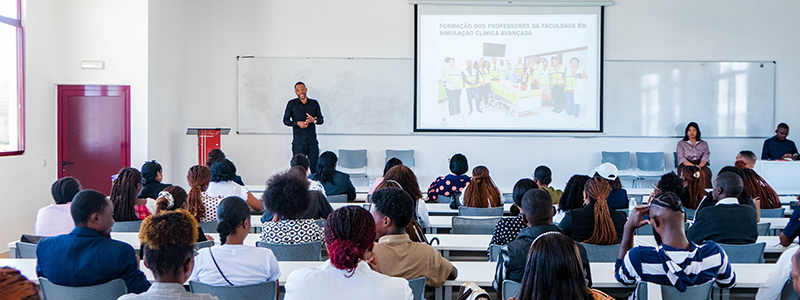
The Faculty of Health Sciences at the International University of Cuanza (UNIC) held a series of scientific presentations, practical demonstrations, and discussion forums focused on pedagogical innovation, clinical simulation, and community health as part of the 2nd Scientific Conference marking the institution’s 6th anniversary.
The activities took place in Room 03 of the Mumbué Building and highlighted the integration of Clinical Simulation, Service Learning, and Community Health, reinforcing the university’s institutional commitment to active teaching methodologies and the practical training of health professionals.
One of the highlights was the presentation of the CLINICALSIM. The international initiative aims to strengthen practical nursing training through advanced clinical simulation.
During the scientific panel, the results of the pilot project developed in partnership with José Eduardo dos Santos University, ORDENFA, and other partner institutions were presented, demonstrating the importance of academic cooperation for the development of new teaching methodologies in the health sector.
The presentations highlighted the progress achieved through the implementation of clinical simulation, including the creation of high-fidelity clinical scenarios, the strengthening of the integration between theory and practice, and the improvement of students’ preparedness for critical situations in a hospital setting.
Experiences related to faculty training, methodological adaptation, and the development of skills related to rapid decision-making, clinical communication, and teamwork were also shared.
Another highlight of the event was the presentation of satisfaction survey results from students at the International University of Cuanza regarding the use of advanced clinical simulation as a teaching strategy.
The study involved 252 nursing students, of whom 88 were in their third year and 164 in their fifth year, revealing high levels of satisfaction in both groups evaluated. According to the data presented, students recognize significant gains in clinical safety, critical thinking, professional autonomy, theory-practice integration, and decision-making ability in simulated contexts.
The results also indicated that more than half of the third-year students expressed high levels of satisfaction with the methodology, reinforcing ClinicalSIM as a relevant pedagogical tool for nursing education and supporting the continuity and expansion of clinical simulation within the institutional context of UNIC.
In the same context, the Service-Learning model was also highlighted, presented as a strategy that combines academic learning, community service, and critical reflection, simultaneously strengthening student training and the social impact of university initiatives in local communities.
The scientific activities were linked to the discussions held, which addressed topics related to the mental health of nursing professionals, family challenges associated with stroke, reproductive health, hypertension, nutrition education, and health promotion through body self-perception.
After the activities concluded, students participated in a practical clinical simulation exercise based on the “Time Game” technique, an innovative methodology that incorporates elements of gamification, rapid decision-making, and the resolution of clinical scenarios in real time.
The activity saw strong student participation and promoted active engagement, teamwork, clinical communication, and the development of clinical reasoning in a safe learning environment.
