


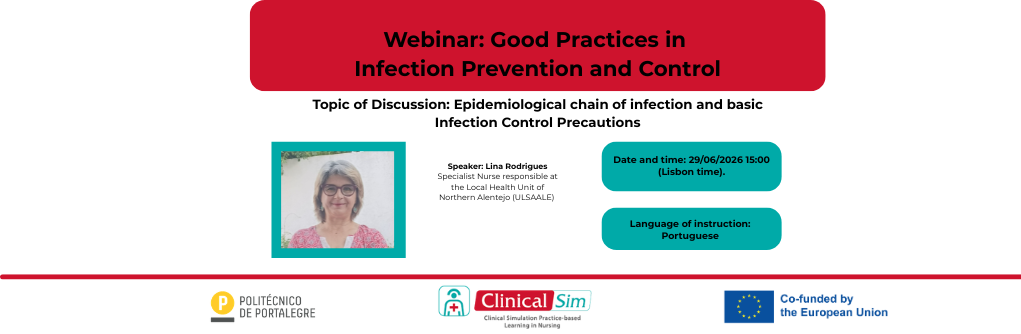
On June 29th at 15:00 (Lisbon), a webinar titled “Good Practices in Infection Prevention and Control” will be held by nurse Lina Rodrigues in the framework of the ClinicalSim project. It will be held in Portuguese.
Healthcare professionals and individuals who wish to improve the effectiveness of infection prevention mechanisms are invited to attend an upcoming webinar that will focus on best practices in infection prevention and control.
Clinical simulation in nursing is a fundamental pedagogical strategy for developing technical and non-technical skills, allowing students to train in a safe and controlled environment. In this context, the integration of Basic Infection Control Precautions is essential, since these practices (such as hand hygiene, proper use of personal protective equipment, and waste management) can be systematically and reflectively practiced during the simulation. By replicating realistic clinical scenarios, simulation promotes the incorporation of these measures into daily practice, reinforcing safe behaviors. In this way, it directly contributes to patient safety by reducing the risk of healthcare-associated infections and preparing future professionals for action based on best practices and the prevention of adverse events.
This webinar will be an excellent platform for discussion of the chain of infection as well as the basics of infection control precautions needed to lower the risk of transmitting infectious diseases.
It will be presented by Specialist Nurse Lina Rodrigues, a specialist from the Local Health Unit of Northern Alentejo (ULSAALE). Based on the skills and experience gained during her work, Rodrigues will discuss the main conditions of infection transmission and share tips on how infections can be prevented.
The webinar is part of the ClinicalSim project and has been sponsored by the European Union, showing the common goal of improving healthcare standards through educational and professional development programs.
Given the continuous presence of challenges from infectious diseases in healthcare, programs like this webinar contribute towards raising awareness, improving professional competences and encouraging evidence-based infection prevention measures.
Those who attend will be able to hear an interesting and useful presentation which underlines the importance of disruption of infection chains and taking necessary preventive steps. This webinar will be particularly useful for professionals working in the healthcare sector and registration can be found through this link.
